
10MICRON
TECHNOLOGY
DESIGN FOR PRECISION
Form Factors
Explore how our optimized mount form factors are specifically engineered for higher stability and demanding applications.
Motion Technology
Discover our proprietary motion control technology, selected for superior tracking performance of professional mounts.
Integrations
Learn about our integration philosophy, designed to ensure reliability, seamless compatibility and simple user control.
Our Encoders
Our Revolution, Our Legacy. Discover how we pioneered the absolute encoder integration in mount design.
Sky Modelling
Find out how our mounts actively model the sky and eliminate errors for superior tracking and revolutionary precision.
Software Suite
Discover our integrated software ecosystem, developed to provide complete operational autonomy and professional-grade support.
MOUNT FORM FACTORS
Here at 10Micron, we have mastered all viable form factors and configurations to meet the requirements of every customer, from the dedicated astrophotographer to the advanced research facility.
At the core of every precision astronomical mount lies its fundamental Form Factor, which dictates how a telescope moves and tracks objects across the sky.
EQ Mount
The Equatorial (EQ) mount design represents the standard for astronomical observation and deep-sky astrophotography. Its axis configuration is specifically engineered to compensate for the Earth's rotation.
-
What defines an Equatorial mount is the Polar Alignment, the critical step where the mount's primary axis, the Right Ascension (R.A.) Axis, is precisely aligned with the Earth's rotational axis (the Celestial Pole).
Once aligned, tracking a celestial object consists of:
Right Ascension (R.A.) Axis: By rotating the telescope solely on this axis at a constant, slow speed (equal to the Earth's rotation speed), the object remains fixed in the eyepiece or camera sensor's field of view.
Declination (Dec.) Axis: This secondary axis is used primarily for pointing and moving the telescope North/South to find the target object.
-
For 10Micron, the Equatorial mount is the historical standard and the foundation upon which our reputation was built.
We achieved global recognition through our best-selling EQ mounts, contributing significantly to the evolution of this product type worldwide. This is our heritage and we proudly carry forward this tradition and technology.
Our engineering focuses on maximizing the EQ advantages: achieving near-perfect tracking accuracy, exceptional rigidity, and advanced GoTo capabilities for the mount ultimate performance.
AZ Mount
The Alt-Azimuth (AZ) is the most intuitive mount design available and represents the standard for rapid visual observation. Its rotational axes are engineered to mirror the basic local coordinates used on Earth.
-
This design relies on two principal axes oriented relative to the local horizon:
Altitude Axis (Vertical): This axis moves the telescope up and down, controlling the object's height above the horizon.
Azimuth Axis (Horizontal): This axis moves the telescope clockwise or counter-clockwise, controlling the object's compass position.
The primary advantage of the AZ design is its ease of setup and use. However it is subject to field rotation when used for long-exposure astrophotography, making it traditionally better suited for visual observation and non-sidereal tracking applications.
-
While the Equatorial form factor is our historic core, the Alt-Azimuth design represents 10Micron's drive for innovation, experimentation.
Our approach to the AZ form factor is to challenge its traditional limitations. We leverage our expertise in high-precision mechanics and advanced software control to develop sophisticated Alt-Azimuth solutions for specialized applications, particularly in areas like satellite tracking, laser communication, and other emerging space applications.
By applying our signature to the AZ design, we ensure that every customer need is met.
Mechanical Configuration
While the Form Factor determines the rotational geometry and tracking method, the Mechanical Configuration defines the physical structure used to support and balance the instrument or the optical tube.
GERMAN CONFIGURATION
The German Mount Configuration utilizes a classic principle of leverage to achieve balance.
-
The optical tube assembly is fixed to one end of the Declination (Dec.) axis.
-
A substantial counterweight is fixed to the opposite end of the axis, perfectly balancing the load of the telescope.
-
We have applied the robust German configuration to both our most popular Equatorial models (GEM) and specialized Alt-Azimuth applications (GAM), leveraging its flexibility and balance principle across different operational needs.
FORK CONFIGURATION
The Fork Mount (Gimbal) Configuration offers a highly rigid, centered support structure.
-
The optical tube is supported precisely between two arms (the fork), which center the mass directly over the mount's main axis of rotation.
-
This inherently centered design does not require separate counterweights, simplifying setup and transportation.
-
We developed high-end mounts utilizing both the Alt-Azimuth Fork and the Equatorial Fork (achieved via an equatorial wedge). This complete offering demonstrates our commitment to delivering the optimal mechanical solution for every use case, from permanent observatory installations to field applications requiring maximum stability.
T-SHAPE CONFIGURATION
The T-Shape Mount (Gimbal) Configuration is designed to support two separate payloads mounted oppositely.
-
This configuration adopts a distinct 'T' shape and is designed for dual, opposing payload support on the Altitude axis. Also, some of our standard GAM mounts can be adapted for T-Shape configurations using a simple conversion kit.
-
The ‘T-Mount’ structural symmetry ensures inherent dynamic balance, and does not require separate counterweights.
-
The Gimbal (T-Mount) Configuration represents our commitment to pioneering technology for the aerospace industry and research sectors. It is our state-of-the-art solution for complex, highly professional requirements in an Alt-Azimuth form factor.
MOTION TECHNOLOGY
The pursuit of the perfect movement of a mount has driven 10Micron's innovation since the 2000s. Motion Technology represents our research and the synergy between movement mechanics, high-end electronics, and software, ensuring efficiency and top-level performance.
We achieve this through two proprietary systems: the traditional, highly-precise Gear Drive (HPS) with a worm to wormwheel solution, and the revolutionary, gearless Direct Drive (DDS) using magnetic motors.
HPS
High Precision & Speed
The HPS series stands for High Precision and Speed, and represents the essence of 10Micron mounts. It is the result of pairing the reliability of stiff mechanics with cutting-edge absolute encoder technology, making it the unique and recognizable signature of our company.
-
10Micron HPS mounts continue to feature the traditional worm to wormwheel drive solution. This trusted Worm Gear is made with high-precision traditional worm-wheel drives and clutches made with B14 bronze, ensuring the best reliability and stiffness.
-
The high precision of the HPS series is achieved thanks to the absolute encoders paired with 10Micron manufacturing.
We revolutionized astronomical motion control by being the first to integrate high-resolution industrial absolute encoders directly onto the mount axes at a fair price for the general market.
This system offers professional-level performance, featuring encoders with over 10 million interpolated increments. Also, the system compensates for nearly all mechanical errors, including periodic error and backlash. This enables HPS mounts to deliver precision comparable to professional direct-drive systems, but utilizing a proven mechanical drive without the inherent complexities of magnetic field manipulation and lower power consumption.
The creation of the HPS technology was driven by a desire to define a new paradigm in astrophotography: the ability to image without the necessity of autoguiding. Traditional autoguiding introduces significant complexities and limitations, while our HPS system is engineered to overcome these hurdles even in the most challenging environments.
This is not the only option; you can still autoguide with our highly accurate mounts, but it is no longer mandatory!
-
The high speed of the HPS series is achieved thanks to high performance electronics and AC servo motors. These AC Servo Motors are high torque brushless servo motors that are maintenance-free, allowing for a pointing speed of up to 20°.
DDS
Direct Drive System
The DDS series stands for Direct Drive System, representing the peak of cutting-edge engineering of 10Micron mounts. These mounts are the indispensable platform for professional research, telecommunication, high-end astronomy, and the aerospace industry.
-
At the core of these mounts are high-torque, high-efficiency, Made in Italy torque motors. This Direct Drive System (DDS) technology is implemented to overcome the constraints of traditional gear-based systems, effectively eliminating mechanical limits and wear, while being optimized for demanding applications.
This technology enable motion through the manipulation of electromagnetic fields, and as such, our research and experience are focused on precisely and efficiently managing these forces.
-
The DDS series is equipped with high-resolution industrial absolute encoders, mounted directly on both axes, which constantly monitor and correct the gearless motor movement enabled by magnetic fields. This critical feedback loop provides the unparalleled pointing and tracking accuracy required for a gearless system.
-
10Micron has developed an integrated Auto-Tuning feature that optimizes Direct Drive motor control parameters. This capability is critical because it ensures maximum stability and data quality for the specific customer payload by eliminating induced resonance or oscillation.
MOUNT INTEGRATIONS
Here at 10Micron, we firmly believe in pushing the boundaries of mechanical innovation, however, we understand that the ultimate measure of our success lies in the user experience. A nice-looking object is simply not sufficient; it must be useful, efficient, and easy to integrate into your workflow.
This commitment has driven us to continuously improve our integration capabilities. The resulting seamless synergy between superior mechanics, advanced electronics, and proprietary software is the true core of the 10Micron identity.
-
Every 10Micron mount incorporates an onboard industrial computer. This is not merely a controller; it's a powerful, dedicated system running a Linux operating system that ensures full, reliable stand-alone management of the mount. This industrial-grade architecture provides the reliability and processing power necessary for advanced features like complex pointing models and real-time corrections.
The system is housed in the Control Box, featuring a powerful ARM mainboard. It is engineered for maximum connectivity and security with optimized ports and high-quality Binder connectors. Key features include:
Robust Connectivity: Guaranteed through robust Ethernet and Wi-Fi connectivity.
Precision Timing: A precise GPS with PPS signal (Pulse Per Second) for highly accurate time and site coordinates synchronization, along with support for leap seconds and full accounting for the UT1-UTC timescale.
Enhanced Interfaces: Dedicated, optimized ports for LAN (Local Area Network), autoguider, and GPS , plus an extended AUX interface.
This highly integrated system provides the operational autonomy and secure, professional connectivity that distinguish 10Micron mounts, ensuring they are ready for any demanding application, from field use to remote observatory management.
-
The integrated Control Unit (Keypad) is designed to provide all necessary functions for field use, requiring no external PC. This critical feature ensures maximum operational autonomy in any location.
The keypad itself is a rugged component, featuring a metal housing and reliable professional micro switches. It is built for demanding environments, equipped with a large graphic display that is heated for operation under the lowest temperatures.
The display and keyboard are both dimmable, with back-lit keys, allowing comfortable use in dark conditions. The large graphic display provides up to five information menu lines for clear visibility of coordinates, object information, and status symbols showing the mount's status and active external connections.
All the functionality of the mount is fully accessible through the keypad, delivering a powerful and self-sufficient control center for all field operations.
-
In line with our commitment to effortless operation, access to mount control and configuration could also be managed through a new, professional WEB interface. This modern interface is accessible directly from any browser, eliminating the need for specialized software and providing complete flexibility across all devices and operating systems.
This powerful feature allows operators in remote locations to fully manage or configure the mounts through a dedicated virtual keypad with full operational functionality, consult manuals, and perform secure firmware updates simply via the robust Ethernet or Wi-Fi (LAN) connection.
Furthermore, the proprietary interface integrates direct management of orbital data, making it easy to download satellite TLE, asteroid, and comet databases. This innovative, browser-based solution provides remote accessibility, security, and a high degree of integration, centralizing all essential operational and maintenance functions in one place.
-
The proprietary 10Micron firmware delivers unparalleled precision and operational flexibility. A critical feature is its sophisticated pointing and tracking modeling, which utilizes up to 100 alignment stars. This extensive modeling allows for the correction of classical errors, such as polar alignment and orthogonality errors, as well as the most important flexure terms of the optical tube.
This advanced capability results in pointing accuracies in the order of 15 arcseconds RMS.
The same model is used to achieve maximum tracking accuracy, incorporating:
Correction for atmospheric refraction (depending on local pressure and temperature).
Support for sidereal, solar, lunar, and custom tracking speeds adjustable on both axes.
Declination-based autoguide speed correction.
Key operational features include configurable pointing and tracking past the meridian (up to 30°), storage of multiple pointing models, and assisted electronic balance adjustment. The firmware also supports Remote Assist via an Internet connection and offers automatic time and site coordinates synchronization via GPS.
The system ensures absolute temporal accuracy by incorporating UTC-UT1 and leap second corrections, with synchronization supported via GPS, PPS signals, or the proprietary ClockSync software. For high-end observatory setups, the firmware facilitates direct RS-232 dome control and dedicated filtering for the precise tracking of comets and asteroids. Furthermore, for users of Direct Drive (DDS) systems, an integrated dynamic Auto-Tuning function is included to automatically eliminate payload-induced resonances, ensuring stability even with complex equipment configurations.
-
The Direct Drive System (DDS) technology incorporates a sophisticated Dynamic Auto-Tuning function, an essential calibration protocol integrated directly into the onboard computer. This technology is engineered to ensure that DDS mounts operate at their theoretical maximum efficiency by optimizing motor control parameters in response to real-world operational variables.
The technical core of the Auto-Tuning system lies in its ability to perform autonomous parameter identification. By analyzing the mechanical response of the system, the algorithm identifies the optimal control coefficients required to drive the motors with high precision. A critical objective of this process is the elimination of resonance and mechanical oscillations. Such disturbances are frequently induced by the specific payload's mass and distribution.
From an operational perspective, the Auto-Tuning function is characterized by its high degree of automation and versatility. It can calibrate the system for any equipment configuration. The procedure is initiated via the mount's integrated keypad and, while requiring a duration of several minutes, operates with complete autonomy.
In conclusion, the Dynamic Auto-Tuning technology represents a fundamental requirement for high-precision motion control. By mitigating the risks of resonance and ensuring consistent stability, it guarantees maximum data quality.
-
Seamless integration and reliable remote mount control are guaranteed through our support for multiple, advanced communication standards. The sophisticated electronic architecture of our mounts is designed to integrate effortlessly into any operational environment, from personal observatories to proprietary automation systems.
We support robust, industrial-grade protocols to ensure high-end compatibility:
CANopen: Supported for integration into sophisticated proprietary automation systems, reflecting our advanced electronic architecture.
ASCOM Drivers: We guarantee control access via astronomy-standard ASCOM drivers, and 10Micron provides a dedicated driver for Windows.
RS232 Protocol: The industrial standard RS232 protocol is also supported to secure broader compatibility. The mount's GPS port doubles as an additional RS-232 port if the GPS is not in use.
For users implementing their own control systems, we provide a command set that is largely LX200 compatible but includes many more advanced functions and operating modes, usable over RS-232, LAN, and WLAN connections.
-
10Micron mounts provide a great deal of connecting options tailored for remote use. While the traditional RS-232 connection remains available (and is often dedicated to controlling a computerized dome), the optimal method for external control is via LAN (TCP/IP) or Wireless connection.
The mount can connect to an existing WLAN or operate as an hotspot for direct connection from your PC, tablet, or smartphone. The LAN connection offers superior high-voltage tolerance compared to RS-232, and the WLAN is even safer against lightning, which is critical for remote observatories.
The mounts support up to ten simultaneous TCP/IP connections, allowing multiple software programs or devices to be used concurrently. For streamlined remote management, the Wake on Power feature enables the mount to automatically boot upon receiving power, allowing seamless activation via remote power switches or networked power strips.
Crucially, 10Micron mounts are able to operate up to 30° beyond the meridian in both directions. This provides an arc of at least 60° for tracking any object, corresponding to a minimum of four hours of tracking for objects crossing the meridian. This is supported by the added security of the absolute encoders, ensuring you never lose alignment, even in the event of slipping clutches.
-
The 10Micron mounts are equipped with a powerful internal object database that provides comprehensive astronomical reference for both observational and research needs.
The database contains numerous star catalogues and an extensive listing of deep-sky objects up to 16th magnitude. Key star catalogues include Bright Star Catalogue, SAO, HIP, HD, and PPM. Deep-sky objects cover M, NGC, IC, PGC, and UGC.
Crucially, the mounts support advanced non-sidereal tracking for objects within the Solar System. The orbital elements for comets, asteroids, and artificial satellites can be easily loaded into the mount, allowing these objects to be tracked directly using the keypad.
The full range of available objects includes:
Stars: By Common Names, Bayer designation, Flamsteed designation, and major catalogues.
Deep-sky: M, NGC, IC, PGC, UGC (limited up to mv = 16).
Solar System: Sun, Moon, planets, asteroids, comets, and artificial satellites, supporting both Equatorial and Altazimuth coordinates.
This extensive database, combined with the ability to upload your own data, ensures that 10Micron mounts are ready for a vast range of targets, from deep-sky exploration to tracking fast-moving, non-sidereal objects.
-
10Micron mounts feature a comprehensive system of accessories for mounting various instruments. Notably, they support the ability to mount multiple instruments on a single mount, ensuring the right imaging equipment is always ready.
Because the pointing and tracking model is specific to the instrument (as the flexure is different for each setup) the mount allows you to save and reload different models for each instrument in its internal memory.
A particularly useful feature, especially for heavier mounts, is the assisted electronic balance function. This function allows you to precisely measure the unbalancing of the instrumentation and adjust it accordingly.
OUR ENCODERS
Our absolute encoder systems are the very foundation of the unparalleled precision intrinsic to every 10Micron mount. We pioneered the integration of high-resolution industrial absolute encoders directly onto the mount axes at a price point accessible to the general astronomy market.
This vision wasn't merely a feature, it was a revolution in astronomical motion control. This commitment to knowing precisely where you are pointing, and where we are headed, is the heritage of 10Micron.
Technology for a New Era of Astronomy
The integration of absolute encoders provides the fundamental technology that elevates 10Micron mounts to a professional-grade category. These on-axis encoders deliver high-accuracy feedback on the mount's motion. The exceptional precision is a direct result of pairing these devices, featuring over 10 million interpolated increments and a resolution of 1/10 arcsecond, with the superior manufacturing standards of our company.
-
Our encoder system ensures that the electronics always know the precise position of the mount, regardless of any zeroing or homing procedure. This capability fundamentally simplifies operation in the field:
Instant Readiness: The mount's position is known even if the clutches are unlocked and the electronics are powered off. You can move the mount manually, lock the clutches in any position, switch it on, and the electronics will immediately know where the telescope is looking.
Dobsonian Mode with Precision: Users can effectively utilize the mount like a Dobsonian telescope with manual pointing, while retaining the full, sub-arcsecond accuracy of the encoders for instantaneous tracking.
Accelerated Setup: This results in a much faster setup procedure, providing exceptional ease of use during field operations.
-
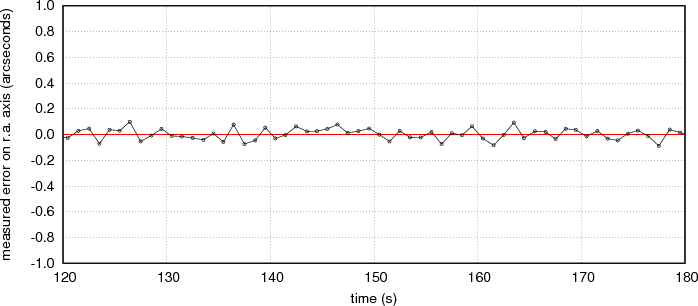
A primary function of mounting the encoder directly on the axis is the immediate compensation for nearly all mechanical errors inherent in the reduction gearing.
Right Ascension Axis (R.A.): For the R.A. axis, the encoder system eliminates virtually all mechanical errors from the reduction gearing. This includes the highly crucial compensation for the Periodic Error (periodic irregularities due to imperfections in the worm manufacturing and assembly), as well as non-periodic errors caused by imperfections in the wormwheel, bearings, belts, and other components.
Declination Axis (Dec.): While the declination axis does not have sidereal tracking motion, the encoder system is at least as important here as it is in R.A. The Dec. axis is critical for sidereal tracking and necessary for slow-speed movements required to compensate for atmospheric refraction, telescope flexure, and mount flexure.
-
The Declination axis operates at near-zero speeds, often involving direction inversion. At these low velocities, traditional mechanical issues become pronounced:
The Problem with Traditional Mounts: Issues like mechanical backlash, belt flexure, and friction forces become significant in the Dec. axis. Traditional mounts try to mitigate these effects through various complex and imprecise methods, such as utilizing very small worm preloads (risking uncontrolled motion), painstakingly calibrating software backlash compensation , or manually adjusting gear meshing. Some methods even rely on forcefully introducing small alignment errors to keep autoguide corrections consistently in one direction.
The Encoder Solution: By having an encoder mounted directly on-axis, 10Micron eliminates the need for these complex and flawed compensations. The direct feedback ensures the control system has the precise position data to manage movement even at these critical near-zero speeds, ensuring stable and highly accurate tracking.
SKY MODELLING
Our mounts achieve their tracking accuracy by constructing a comprehensive software model of the entire observing environment and mechanical system. This Sky Modelling process is systematically broken down into six fundamental sub-tasks, each addressing a critical source of potential error to ensure maximum performance and data quality.
-
This initial step ensures the mount's software accounts for any deviation from the ideal polar alignment. An ideal equatorial mount's right ascension (RA) axis points directly at the celestial poles. If there are errors in this alignment, the mount will exhibit various pointing and tracking errors across the sky in both axes.
Traditionally, achieving an ideal alignment is crucial to allow the mount to track objects by setting a constant RA velocity. However, 10Micron mounts eliminate this constraint. By pointing at two or three stars during the initial alignment procedure, the firmware computes the precise polar misalignment. This information is then used not only for highly accurate pointing but, critically, for correcting the tracking of objects. This means tracking remains correct even if the mount is not perfectly aligned to the celestial pole.
While a reasonably correct alignment is still recommended to avoid field rotation on long imaging sequences, the 10Micron firmware provides functions, including the number of turns required on the adjustment handles for azimuth and altitude, to simplify this process. This advanced initial alignment eliminates the need for a polar scope, favoring mechanical stiffness, and is significantly faster and easier than traditional methods. Accurate knowledge of time and location (via keypad, external PC, or optional GPS module) is essential for this step.
-
The optical axis of the telescope is rarely perfectly aligned. Errors arise when the telescope's optical axis is not perfectly perpendicular to the declination axis, or when it is not perfectly aligned with the zero angle of the absolute encoder.
These two specific geometric errors are automatically computed and corrected by the firmware as soon as you add the third star to the initial alignment procedure.
-
No mechanical system is ideal, and even with high-accuracy on-axis encoders, mechanical flexure remains a primary source of error. A deformation of just 5 thousandths of a millimeter (0.005 mm) in a tripod leg can introduce a one arcsecond error during an exposure. Such minor deformations are easily caused by shifts in the barycenter of a non-perfectly balanced telescope.
The solution is to build a software model that accounts for the mechanical flexure of both the mount and the telescope. This requires pointing to various locations in the sky and comparing the star's actual position against the angle read by the mount's axes encoders.
With 10Micron mounts, this flexure model can be created simply by adding stars to the initial alignment procedure , utilizing up to 100 alignment stars/points. This process can be highly automated using external tools that employ "plate solving" to feed exact coordinates back to the mount. The entire procedure is fast, thanks to the high pointing speed. This modeling relies on mechanical errors being repeatable (like flexure) and not on mechanical play or backlash, which are eliminated by the on-axis encoders.
-
The Earth's atmosphere bends the rays of light from astronomical objects, a phenomenon known as atmospheric refraction, based on air density.
While traditional mounts might advise using a special "King" tracking speed to compensate for refraction in RA only, 10Micron mounts allow the user to input the barometric pressure and atmospheric temperature. This data can be entered manually or via an external PC and can be updated continuously during an observation session to account for atmospheric changes, ensuring continuous correction of both pointing and tracking.
-
Beyond the obvious daily rotation, subtle effects related to Earth's movement must be modeled for high-precision.
Earth Rotation Rate: Most electronics use quartz oscillators for timekeeping, but these are often not temperature compensated or highly accurate. At typical observation temperatures like -5°C, a typical quartz error of 20-30 ppm can cause an error accumulation of over one arcsecond per hour. All 10Micron motor drivers feature a battery-backed clock with temperature compensation that maintains an accuracy of 3.5 ppm across a wide temperature range -40°C to +40°C. The clock can also be synchronized to an external time source or the optional GPS module.
Precession and Nutation: Precession of the equinoxes is a fundamental, slower movement that changes the direction of the Earth's rotation axis (the celestial pole). Failing to model precession would destroy pointing accuracy within minutes. The 10Micron firmware accounts for precession, nutation, and light aberration. By default, the mounts communicate using JNOW coordinates (true equinox of the date of observation).
UTC vs. UT1: The widely used UTC time is an approximation of the Earth's true angle of rotation, measured by UT1. Since UTC is based on atomic clocks, a "leap second" is occasionally inserted to keep it within 0.9 seconds of UT1. Approximating UT1 with UTC can introduce a difference of up to 14 arcseconds in pointing accuracy, and the insertion of a leap second causes a sudden jump in coordinates. Now 10Micron implements a full accounting of UTC, UT1, and leap seconds.
-
Finally, the mount must accurately model the visible movement of objects other than fixed stars.
Objects like planets, asteroids, comets, and artificial satellites exhibit motion that must be tracked. The firmware can compute the motion of planets directly, and track other objects (like asteroids and comets) by uploading their orbital parameters. Tracking for Solar System objects is automatic when the "Follow object" setting is on.
Crucially, 10Micron mounts account for the appreciable motion of the Moon in declination, which is often omitted by other mounts. Artificial satellites are tracked using a dedicated special function.
-
This comprehensive, integrated Sky Modelling approach is the reason 10Micron mounts can deliver superior performance without the necessity of autoguiding.
Autoguiding introduces additional complications for the user: uncompensated flexures between the main telescope and an external guider scope, extra heavy equipment, more cabling and software, the trouble of finding suitable guide stars, and calibration.
With 10Micron, you align to bright stars during twilight, and every second of darkness is then dedicated to imaging. Furthermore, autoguiding is often impossible when imaging faint, fast-moving objects like comets. For users who still wish to use it, the mounts provide a standard ST4 port and all the usual remote control settings.
SOFTWARE SUITE
Beyond its high-precision hardware, the 10Micron ecosystem provides an open software architecture designed for total operational autonomy and professional-grade support. Each mount includes a dedicated suite of proprietary utilities and drivers designed to optimize the professional workflow.
System Management and Support
Central to our software philosophy is the long-term reliability of the instrument. We provide dedicated utilities for performing complete Configuration Backups, allowing users to save the exact state of their mount's internal settings, pointing models, and parameters for instant restoration. Furthermore, our proprietary Mount Logger utility generates detailed diagnostic data files, which are essential for proactive maintenance and technical analysis. Distinctively, 10Micron offers a dedicated Remote Assist software, a unique feature, which facilitates direct, secure connections for expert support and troubleshooting.
An Open System and Collaborative Integration
We firmly believe in an open-platform approach, recognizing that modern astronomy often relies on a synergy of different tools. We maintain direct and active collaborations with developers of popular platforms such as N.I.N.A., ensuring that our users benefit from a seamless, "plug-and-play" experience. By combining our proprietary high-end utilities with an open-source compatibility mindset, we provide a software environment that is as versatile and reliable as the hardware it controls.